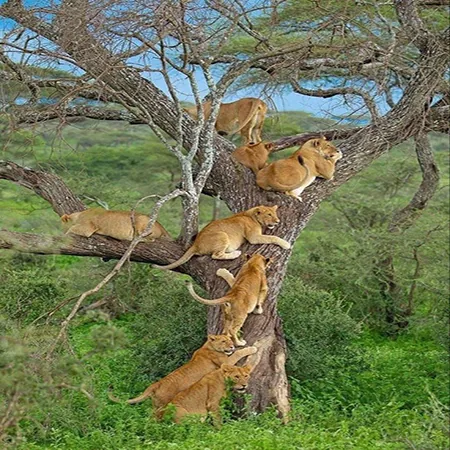
The Tree-Climbing Lions of Lake Manyara
Lake Manyara is famous in safari circles for its lions, which regularly climb acacia and fig trees and rest in the branches — a behavior observed in very few lion populations worldwide (most notably Uganda's Ishasha region and Manyara).
No one knows definitively why Manyara's lions climb. Theories include: escaping ground-level insects, a better view of prey, or simply learned behavior passed down through generations. Whatever the reason, a lion draped across a branch 6 meters off the ground is a startling and memorable sight.
Sightings aren't guaranteed, but Manyara's lions are resident and encountered reasonably regularly year-round.
Flamingos and the Soda Lake
Lake Manyara itself is an alkaline soda lake that extends across most of the park's area. In productive years it hosts hundreds of thousands of lesser flamingos, turning sections of the shoreline pink from a distance.
Flamingo numbers fluctuate dramatically based on water levels and salinity — peak flamingo concentrations are often best November through May. The lake also hosts large hippo pods and countless waterbirds.
The Groundwater Forest: Africa's Most Lush Safari Habitat
The park's entrance section is dominated by a dense groundwater forest fed by springs from the Rift Valley escarpment. This is genuinely different from anything in the Serengeti or Tarangire — cathedral fig trees, baboon troops, blue monkeys, and abundant birdlife in a jungle-like setting.
This section is one of the best places in Tanzania for primate watching: troops of olive baboons, family groups of blue monkeys, and the occasional vervet move through the canopy above the game drive track.