How Fit Do You Need to Be to Climb Kilimanjaro?
You need to be fit enough to walk for five to eight hours a day on several consecutive days, and to manage a summit night of 12–15 hours on your feet. You do not need climbing skills or exceptional strength. Most reasonably healthy people who prepare well can do it.
The fitness that transfers best to Kilimanjaro is:
- Cardiovascular endurance for sustained, moderate effort over many hours
- Leg strength and stability for steep ascents and, especially, long descents
- Time on your feet in hiking boots, carrying a daypack
- Mental endurance for summit night, walking through the night in the cold
Gym strength, sprinting and sport-specific fitness matter much less. Altitude is the real challenge, and no amount of training at sea level fully prepares you for it, which is why the route and number of days you choose matter so much.
What Does the 12-Week Kilimanjaro Training Plan Look Like?
The plan builds your aerobic base first, then your endurance, then simulates consecutive mountain days, before a final week of rest. Adjust it to your starting fitness, and check with your doctor before starting if you have any health concerns.
| Weeks | Focus | During the week | Weekend hiking |
|---|---|---|---|
| 1–4 | Base aerobic fitness | Cardio 4–5 days a week, 30–45 minutes (running, cycling, swimming, brisk walking) at a comfortable effort | One hike of 2–3 hours on moderate terrain |
| 5–8 | Sustained endurance | Cardio 4–5 days a week, building to 45–60 minutes; add two short strength sessions | One or two hikes, building to 4–5 hours, with as much uphill as you can find |
| 9–11 | Kilimanjaro simulation | Keep cardio and strength going; add stair climbing with a pack | Back-to-back hikes: 4–6 hours on Saturday, then 3–4 hours on Sunday, carrying 5–8 kg |
| 12 | Taper and rest | Cut training by about half; light cardio only | An easy walk; focus on sleep, food and hydration |
What Does a Typical Training Week Look Like?
A typical week in the middle of the plan, around weeks 6 to 9, balances cardio, strength, hiking and rest. Use it as a template and swap activities to suit your schedule.
| Day | Session |
|---|---|
| Monday | Rest or gentle stretching |
| Tuesday | 45–60 minutes of cardio, such as running, cycling or an incline treadmill walk |
| Wednesday | Strength session (see below), 30–40 minutes |
| Thursday | 45–60 minutes of cardio, including some hills or stairs |
| Friday | Rest, or a short easy walk |
| Saturday | Long hike of 4–6 hours with a loaded daypack |
| Sunday | Second hike of 3–4 hours, or a long brisk walk |
Which Strength Exercises Help Most on Kilimanjaro?
Strength training helps most on the descents, which put heavy load on your knees and thighs, and on the steep sections such as the Barranco Wall. Two short sessions a week are enough.
- Step-ups onto a bench or stair, with a daypack
- Walking lunges and reverse lunges
- Squats, progressing to goblet squats
- Slow step-downs from a step, to prepare your knees for descents
- Calf raises for steep ground
- Planks and side planks for core stability with a pack
Trekking poles take a lot of strain off your knees on the way down, so practise hiking with them during training.
How Should You Prepare Your Gear While Training?
Use your training hikes to test the clothing and equipment you will take to Kilimanjaro. Blisters and uncomfortable kit are easy to avoid if you find the problems at home.
- Break in your hiking boots over several long hikes
- Hike with the daypack you will carry, loaded to 5–8 kg
- Practise with trekking poles, especially on descents
- Test your layering system in cold or windy weather
- Try the snacks and drinks you plan to take on summit night
See our complete Kilimanjaro gear list for everything you will need.
Can You Prepare for the Altitude?
You cannot fully prepare for high altitude while living at sea level, and fitness does not protect you from altitude sickness. The most effective preparation is choosing an itinerary with enough days to acclimatise, such as the 7-day Machame or 8-day Lemosho.
If you have the chance, hiking at moderate altitude in the weeks before your trip can help you learn how your body reacts. Some climbers also discuss altitude medication with their doctor. Our guide to improving your summit chances covers altitude sickness in detail.
How Should You Prepare Mentally for Summit Night?
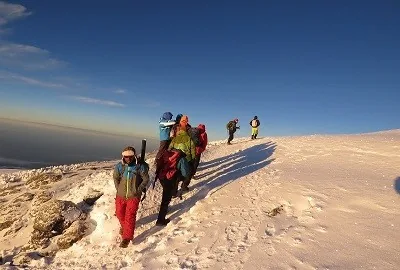
Summit night is the hardest part of the climb. You start around midnight, walk slowly uphill in the cold and dark for six to eight hours, and then descend a long way. Mental preparation helps as much as physical training.
- Expect it to be hard, and accept that slow progress is normal
- Break the climb into small goals, from one rest stop to the next
- Practise long hikes when you are tired, such as the second day of a back-to-back weekend
- Trust your guide's pace, even when it feels too slow
- Remember that the crater rim is only one to two hours from Uhuru Peak
What Do Our Guides See in Climbers Who Reach the Summit?
After accompanying many climbers, our guides notice clear patterns.
Climbers who reach the summit tend to
- Walk slowly without being told, because they understand pole pole
- Stay relaxed and unhurried in camp
- Eat and drink regularly, even when they are not hungry
- Have trained with consecutive hiking days, not just in the gym
Climbers who struggle tend to
- Start too fast on the first days and tire by the middle of the climb
- Underestimate how hard summit night is
- Skip meals when altitude reduces their appetite
- Have gym-based fitness rather than hiking endurance
One finding often surprises people: very competitive athletes sometimes struggle because they push the pace, while steady hikers who know their own rhythm often do well.
Training Checklist Before You Fly
- Completed several hikes of five hours or more
- Done at least two back-to-back hiking weekends with a loaded pack
- Broken in your boots and tested your gear
- Practised with trekking poles on descents
- Seen your doctor about vaccinations and altitude medication
- Bought travel insurance that covers trekking up to about 6,000 m
- Booked a route with enough days to acclimatise
Ready to choose your climb? Compare routes, days and prices on our Kilimanjaro climbing page.